

The history of coir dates back to the 19th century. It all started in the state of Kerala. The state of Kerala can be seen as a thin strip on the map of India. Everything in Kerala revolves around the coconut. It is named after the Malayalam word “Kera,” which means coconut tree. The Coir Industry has expanded its roots from there, and today it plays a prominent role in generating revenue and business in Karnataka, Tamil Nadu, and other neighboring states. The first coir factory in India was set up in Alleppey.
Today, the coir industry is involved in manufacturing a wide range of coir products such as coir rugs, coir sheets, coir door mats, coir blankets for soil stabilization and slope protection, and its related products, and many new and innovative products. All of this began with the manufacturing of simple coir ropes.
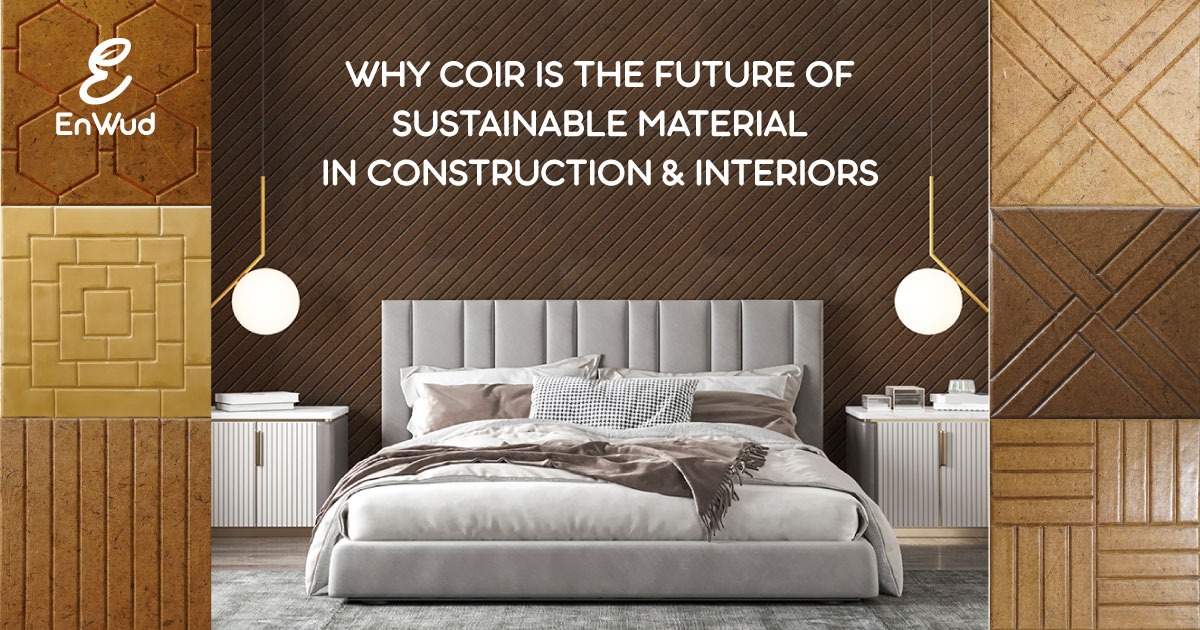
In recent times, the usage of coir is not only limited to the traditional arena of applications, but it has also been widely recognized as a replacement and alternative to conventional wood and wood-based products. The manufacturing of wooden products leads to the cutting down of trees, which impacts the environment and disrupts the climate change cycle. The continuous R and D in adopting coir wood for making all conventional wooden furniture has opened doors to new horizons.
Coir is a biodegradable material, and hence its use is eco-friendly and is a part of climate-resilient engineering practice. The extraction of coir fibers and their subsequent processing into different products is a very effective step to reduce the impact of human consumption on the environment and to return to nature its beauty and assets as much as possible. However, a lot of work needs to be done in this direction. For example, citizens must be made aware of the current status of the coir industry and how its growth will enable our country to become a strong, sustainable, and revenue-earning mechanism.
How coir geotextiles prevent soil erosion
The use of a coir blanket on the subgrade of unpaved rural roads is also applied for improving the strength and durability characteristics of the road, and has also been worked upon successfully. These unconventional usages of coir are very much a necessity in today’s times when man is looking for all options for the conservation of the environment, and is a green civil engineering material. The use of coir and its products in a wide spectrum will be helpful not only for boosting the economy, but it will enable a sustainable infrastructure solution. It is surely bound to become a low-impact road construction material.
Benefits of coir mats in infrastructure projects
The coir erosion control sheets are self-repairable as well as economical in comparison to other traditional erosion control methods. It is suitable for long-term applications to ensure safety against sliding as well as for providing vegetative cover. The installation method is also rapid and is executed with a reduced labor cost than stone-pitching. The coir mat is a bioengineered geo-composite crafted from non-woven natural fibers and woven synthetic lattice. Designed to perform all geotextile functions, it effectively combats surface soil erosion, ensuring long-term slope stabilization and environmental sustainability.
Coir wood as a replacement for conventional timber wood!!!!
The use of coir wood as a replacement for timber wood will not only prevent the cutting of trees, but it will also promote and encourage further plantation of trees. Coir wood possesses the excellent property of being biodegradable and sufficiently flexible to allow itself to be used for a large spectrum of uses ranging from false ceiling lights columns, partitions and paneling work, holders, side supports for sofas, chairs, different types of easy-to-install furniture’s for disaster relief works, and many other applications. As per a recent notification, railways will use coir wood to manufacture the seats and berths. This is a major transition in the booming coir industry. As per a statement issued recently by the Coir Board, it aims to increase its exports threefold by the year 2025. With such a vision and dedicated approach, the coir wood industry can make enthralling progress in the coming years. This will be a major payback for humans towards nature.
Guilt-free gardening using biodegradable and plastic-free accessories!!
Gardening is a key area of application replacement of wood and plastic products can be brought about by the use of coir-based products. Coir-based substitutes for planters and plots offer a multitude of benefits as climate-smart gardening and an example of zero-waste gardening. Coir-based planters are used nowadays in many DIY eco garden setups and are a beneficial green gardening hack of 2025. It is a plastic-free gardening idea, a suitable organic gardening trend, and gardening with sustainable techniques with coir products.
Use of coir-based products in the future will aid in carbon sequestration and enable the step towards the attainment of carbon-negative status for India.
By Dr. Manali Date